
Fast-growing recruitment firms can lose control of user access because hiring, role changes and new software often move faster than access-management processes. Common risks include excessive permissions, dormant accounts, shared credentials, unmanaged applications and access that remains active after someone leaves. Each creates another route to candidate or client information that should be available only to people who need it.
Recruitment businesses can hold significant volumes of personal and commercially sensitive information, including CVs, employment histories, salary information, contact details and, in some cases, identity or right-to-work documents. Effective access management therefore matters for both security and data protection.
What are the main user access risks in recruitment firms?
The main risks are excessive permissions, orphaned accounts, weak credential practices, unmanaged software and inconsistent joiner, mover and leaver processes. The ICO says access to personal data should be limited to users who reasonably need it for their role and removed when it is no longer required.
| Access risk | Why it creeps in as you grow | What it puts at stake |
|---|---|---|
| Excessive permissions | New joiners inherit broad access copied from colleagues | Candidate and client information becomes visible beyond those who need it |
| Orphaned or dormant accounts | Leavers, temporary staff and contractors are not fully deprovisioned | Active accounts remain available without a legitimate user |
| Shared and reused logins | Teams share accounts or reuse credentials | Poor accountability and greater exposure if credentials are compromised |
| Unmanaged apps | Staff adopt SaaS tools without security or procurement review | Business data sits outside approved security, retention and backup arrangements |
| Slow offboarding | Access removal relies on manual, inconsistent processes | Former staff may retain access to business systems and information |
These are often process failures rather than sophisticated attacks. An honest audit of dormant accounts and unused tools is therefore a sensible starting point.
Why growth is the moment control slips
Rapid recruitment creates new accounts and permissions every week. New teams add specialist tools, while expansion into another office or country introduces more users, devices and systems.
Access is often granted quickly so that new employees can become productive, but those permissions may remain long after responsibilities change. The NCSC recommends issuing the minimum required access rights, reviewing access when users change roles and revoking rights that are no longer needed. Its Cyber Assessment Framework also expects periodic access reviews, with at least annual review used as an indicator for well-managed essential systems.
For firms where informal IT processes are becoming difficult to manage, IT support for growing businesses can help formalise access management. Outsourcing your IT to an MSP or using dedicated IT consulting can also establish repeatable joiner, mover and leaver procedures.
International growth adds further considerations, including different offices, devices and data flows. European IT support and global IT support for international projects can help businesses maintain consistent controls across locations.
Recruitment data needs strong access controls
Recruitment businesses commonly process extensive personal information. Whether the agency is a controller or processor depends on the particular processing activity: under UK GDPR, a controller is the organisation that determines the purposes and means of processing, while a processor acts on another controller’s instructions. A recruitment firm will commonly be a controller for processing where it decides why candidate or client personal data is collected and how it will be used.
Under UK GDPR and the Data Protection Act 2018, serious infringements can attract a maximum penalty of £17.5 million or 4% of an undertaking’s worldwide annual turnover in the preceding financial year, whichever is higher. The actual penalty depends on the circumstances and seriousness of the infringement.
Access controls reduce the number of people who can see or alter personal information and make it easier to demonstrate how data is managed. They also help when handling subject access requests. Why IT compliance matters ultimately comes back to understanding where information is held, who can reach it and why.
Smaller businesses are not immune to cybercrime. Our article explaining why Attackers often prefer smaller companies looks at how weaker controls can create opportunities.
Credentials deserve similar attention. Recruitment teams may use an ATS, CRM, job boards, LinkedIn, Microsoft 365 and specialist applications. Dark web monitoring can help identify exposed credentials, while what to do if company credentials appear on the dark web covers the response.
The leaver problem: access that walks out the door
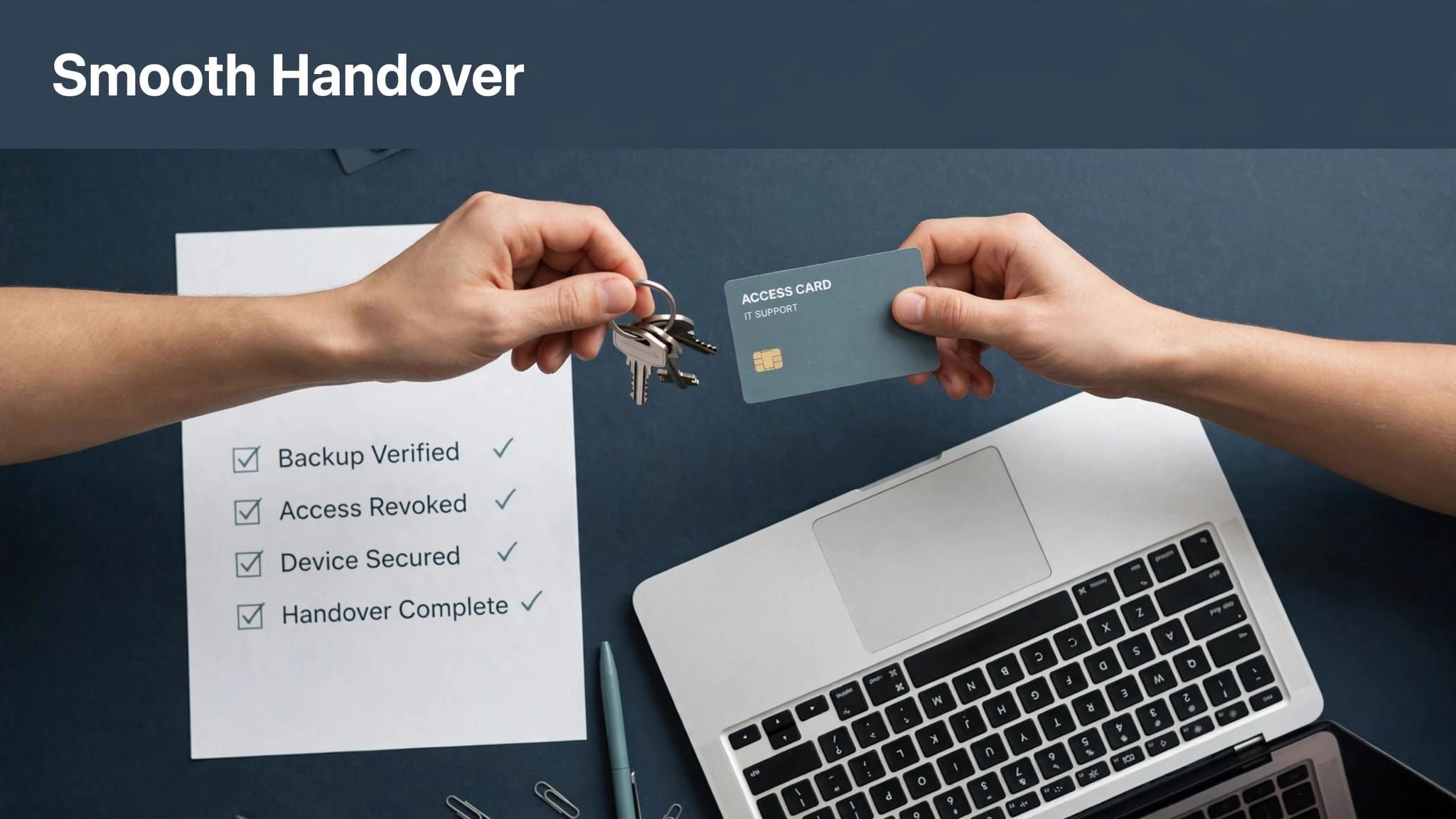
Offboarding should be treated as a security process as well as an HR task. Email may be disabled while access to the CRM, ATS, cloud storage or third-party platforms remains active.
The timing needs to reflect the circumstances. For a normal departure, access should be removed promptly when the individual’s role ends. Where there is a genuine security risk, an organisation may decide to restrict access earlier as part of a managed HR and security process rather than applying a blanket rule to everyone serving notice.
External sharing and guest links also need reviewing because shared files and guest permissions can remain active after the employee who created them has left.
| Offboarding step | Why it matters |
|---|---|
| Disable sign-in at the appropriate point in the exit process | Prevents continued access once it is no longer authorised |
| Revoke CRM, ATS and job-board access | Removes access to key candidate and client systems |
| Remove company data from managed devices and apps | Reduces the risk of retained synced information |
| Change shared credentials the person knew | Prevents old shared credentials remaining usable |
| Review external shares and guest access | Stops unnecessary external access surviving the employee’s departure |
How to regain control of user access
The practical aim is to make permissions deliberate. Apply least privilege, review access when roles change and remove permissions when there is no longer a business need. The ICO specifically recommends limiting access to users who reasonably require it and validating that technical permissions match documented access rights.
A few measures make the biggest difference:
- Use role-based, least-privilege access. Avoid copying a previous employee’s permissions without checking what the new person actually needs.
- Document joiner, mover and leaver processes. Account creation, role changes and exits should trigger consistent changes across every relevant platform.
- Use stronger authentication. MFA can still be phished, so use phishing-resistant options where supported. The NCSC recommends passkeys over passwords where available because passkeys are resistant to phishing. See our guidance on passkeys and stronger sign-in and password best practices.
- Manage business data on devices. Microsoft Intune can apply device and app-management policies. On supported personal devices and managed apps, app-protection policies can restrict movement of organisational data and selectively remove company app data without wiping the user’s personal information. This is particularly useful for remote and hybrid teams.
- Identify unapproved applications. That includes ordinary SaaS and shadow AI tools that employees may use with candidate information.
- Review access regularly. The appropriate frequency should be risk-based. Rapidly growing firms may choose quarterly reviews, but quarterly review is not a universal legal or Cyber Essentials requirement.
- Use layered controls. A zero trust approach can help organisations verify access based on identity, device and context rather than assuming that being inside the network makes a request trustworthy.
Network penetration testing can identify exploitable weaknesses within its agreed scope, but it does not replace access reviews or joiner, mover and leaver controls. Sector-specific IT support for recruitment agencies can bring those controls together around the systems recruiters actually use.
Frequently asked questions
What is user access control in a recruitment agency?
It is the process of deciding who can access systems and information and what they are allowed to do. In recruitment, that can include ATS and CRM platforms, email, job boards, cloud storage and other business applications.
How often should a recruitment firm review user access?
There is no universal UK GDPR rule requiring quarterly reviews. Access should always be reviewed when people join, change roles or leave, with periodic reviews based on risk. The NCSC’s Cyber Assessment Framework uses at least annual review as an indicator for well-managed essential systems; fast-growing firms may reasonably choose more frequent reviews.
What should happen to a recruiter’s access when they leave?
Access should be removed promptly when it is no longer authorised. Review the person’s email, CRM, ATS, job-board accounts, cloud storage, managed devices, external shares and any credentials they knew. Earlier restriction may be appropriate for a specifically assessed higher-risk departure.
Does Cyber Essentials cover user access control?
Yes. User access control is one of the five technical controls in the government-backed Cyber Essentials scheme, alongside firewalls, secure configuration, security update management and malware protection. The current requirements also emphasise controlling access and avoiding unnecessary privileges.
Getting a grip before the next growth spurt
Access sprawl is easier to manage when responsibilities, permissions and offboarding processes are documented before the next hiring surge. If your firm is growing and you are uncertain who can currently reach candidate or client information, reviewing users, applications and privileges is a practical place to start.
Northern Star provides managed IT support in London and security support for growing businesses. Call the team on 0800 319 6032 or request a callback to review your current access controls.