Healthcare IT support needs to protect clinical access, patient data and recovery capability, not simply resolve tickets. A fast service desk response can still leave appointments disrupted if nobody owns the clinical application, network connection or supplier escalation.
Secure planning starts with defined responsibilities, tested recovery and support commitments that match your operating hours. Compare providers against those requirements before comparing monthly prices.
Key Takeaways
- Define who owns the service desk, infrastructure, clinical applications, supplier escalations and recovery tasks before support begins.
- Choose managed support or contract staffing based on the responsibilities and capacity your organisation needs to retain.
- Set access controls, supplier requirements and incident priorities around UK data protection duties and clinical risk.
- Set recovery point and recovery time objectives for each clinical system, then test complete restoration.
- Compare contracts by scope, service hours, exclusions, project costs and exit terms, not by monthly fee alone.
What healthcare technology support should cover
A managed service normally covers user assistance, device maintenance, security monitoring, patching, backups and supplier coordination. Clinical applications need separate attention because a provider may manage the workstation without controlling the electronic patient record system or its hosting platform.
Separate front-line and wider support
The service desk is the contact point for incidents and requests. Wider IT support covers infrastructure maintenance, security administration, capacity planning and technical projects.
Tier 1 handles basic issues such as password resets and initial diagnosis. Tier 2 investigates more complex device, network and application problems. Tier 3 provides specialist engineering and escalations. Define when tickets pass from the service desk to clinical software suppliers, so they don’t circulate between teams.
Inventory EHR systems, patient portals, prescribing tools, scanners, connectivity and authentication services. Include NHS Spine dependencies where relevant, but don’t assume every provider can maintain those integrations.
Continuous monitoring and planned patching support cybersecurity, but every alert needs an owner and an escalation route. Unsupported devices need replacement plans or compensating controls. Our vulnerability management services address weaknesses that routine ticket handling may leave unresolved.
Choose managed support or contract staff
Managed IT support provides an ongoing service with agreed responsibilities, tools and performance commitments. Contract staffing provides engineering capacity under an agreed assignment. Either model can support an NHS organisation, but each leaves different management responsibilities with the customer.
Managed services provide an operating function
A managed IT services provider normally supplies its own service desk, ticketing platform, monitoring tools and escalation process. The contract should assign responsibility for maintenance, reporting and coordination with other suppliers.
Recurring fees can move some expenditure into operating costs. Hardware purchases, migrations and major clinical-system changes may still require separate capital or project budgets.
Contract staffing fills defined capacity gaps
Contract staffing places vetted engineers into short-term or long-term assignments. NHS organisations use it for projects, vacancies, specialist skills, holiday cover and sickness absence.
The organisation usually retains responsibility for IT support, including priorities, supervision and service performance, unless the agreement says otherwise. An engineer covering a vacancy doesn’t automatically provide overnight monitoring, incident management or disaster recovery. Define the assignment and its management separately.
Map UK compliance to practical controls
UK GDPR and the Data Protection Act 2018 govern how healthcare organisations process and protect patient data. Outsourcing support doesn’t transfer the organisation’s accountability for its processing decisions.
Protect health data and control supplier access
Health information is special-category personal data. Processing requires a lawful basis and an applicable special-category condition, as explained in the ICO’s UK GDPR guidance.
Document controller and processor roles, processing instructions, subcontractors, retention and international transfers in supplier reviews and information governance records. Cloud storage doesn’t remove these obligations.
Apply least-privilege access, multifactor authentication, separate administrator accounts and usable audit logs to support data security. Staff also need clear reporting procedures; our cyber security awareness training supports that operational requirement.
For US covered entities and relevant business associates, HIPAA compliance sets a separate framework with access controls and audit documentation. HIPAA compliance is relevant when a supplier acts as a business associate to a covered entity. HIPAA compliance doesn’t establish GDPR compliance in the UK.
Treat NHS assurance and certifications separately
The Data Security and Protection Toolkit provides NHS assurance, with a distinct assessment category for IT suppliers. A supplier’s assessment doesn’t replace the healthcare organisation’s own responsibilities.
Cyber Essentials provides evidence against baseline technical controls. Cyber Essentials Plus adds independent technical testing. Neither proves that every clinical system or recovery process is secure.
ISO/IEC 27001 certification concerns an information security management system. Its scope needs to include the contracted service activities. These credentials support supplier assessment; they don’t replace contractual controls, technical evidence or NHS information governance requirements.
Set response commitments around clinical risk
A service-level agreement (SLA) should define incident priorities, acknowledgement, technical engagement, restoration targets, updates and escalation. Response time alone doesn’t show how quickly clinicians regain access.
BCN’s G-Cloud 14 healthcare listing provides a concrete comparison benchmark. Its standard hours are 08:00 to 18:00 Monday to Friday, with extended hours of 07:00 to 19:00.
The listed response targets distinguish in-hours support from restricted overnight cover.
| Priority | Standard or extended hours | Out-of-hours response |
|---|---|---|
| P1 | Within 30 minutes | Within 60 minutes |
| P2 | Within 2 hours | Not included in the stated P1 cover |
| P3 or P4 | Within 4 hours | Not included in the stated P1 cover |
Its out-of-hours provision offers 24/7 support for P1 incidents only, except on Christmas Day. These supplier-specific terms aren’t an NHS-wide standard.
A 30-minute response target can be met while a clinical system remains unavailable. Restoration targets and escalation responsibilities need separate wording.
Define priorities through clinical impact, including unavailable prescribing, inaccessible records and site-wide connectivity failures. Specify whether the response clock pauses during supplier escalation.
Major incidents also need named decision-makers and containment authority. Our cyber incident response services address security incidents that require investigation and recovery beyond routine troubleshooting.
Plan cloud access and tested recovery
Cloud platforms can improve record availability, but availability depends on connectivity, identity services and application design. Backup planning must address failures in those dependencies as well as lost data.
Define access requirements before choosing infrastructure
Well-designed cloud systems can give clinicians near-instant record access and let patients view laboratory results or prescription information through connected portals. Hosting alone doesn’t provide those integrations or permissions.
Separate clinical hosting decisions from email, collaboration and general file storage. Microsoft 365 isn’t automatically an appropriate repository for every clinical record workflow. Microsoft 365 data and configuration also need a suitable recovery plan. Our Microsoft Azure services cover cloud setup, security, migration and ongoing management, with responsibilities defined around the environment.
Test restoration against acceptable disruption
A recovery point objective (RPO) defines acceptable data loss measured in time. A recovery time objective (RTO) defines the target time to restore a service.
Set these requirements for each clinical system, and include them in disaster recovery plans and restoration tests. A generic daily schedule may leave an unacceptable gap for records created throughout a clinic session.
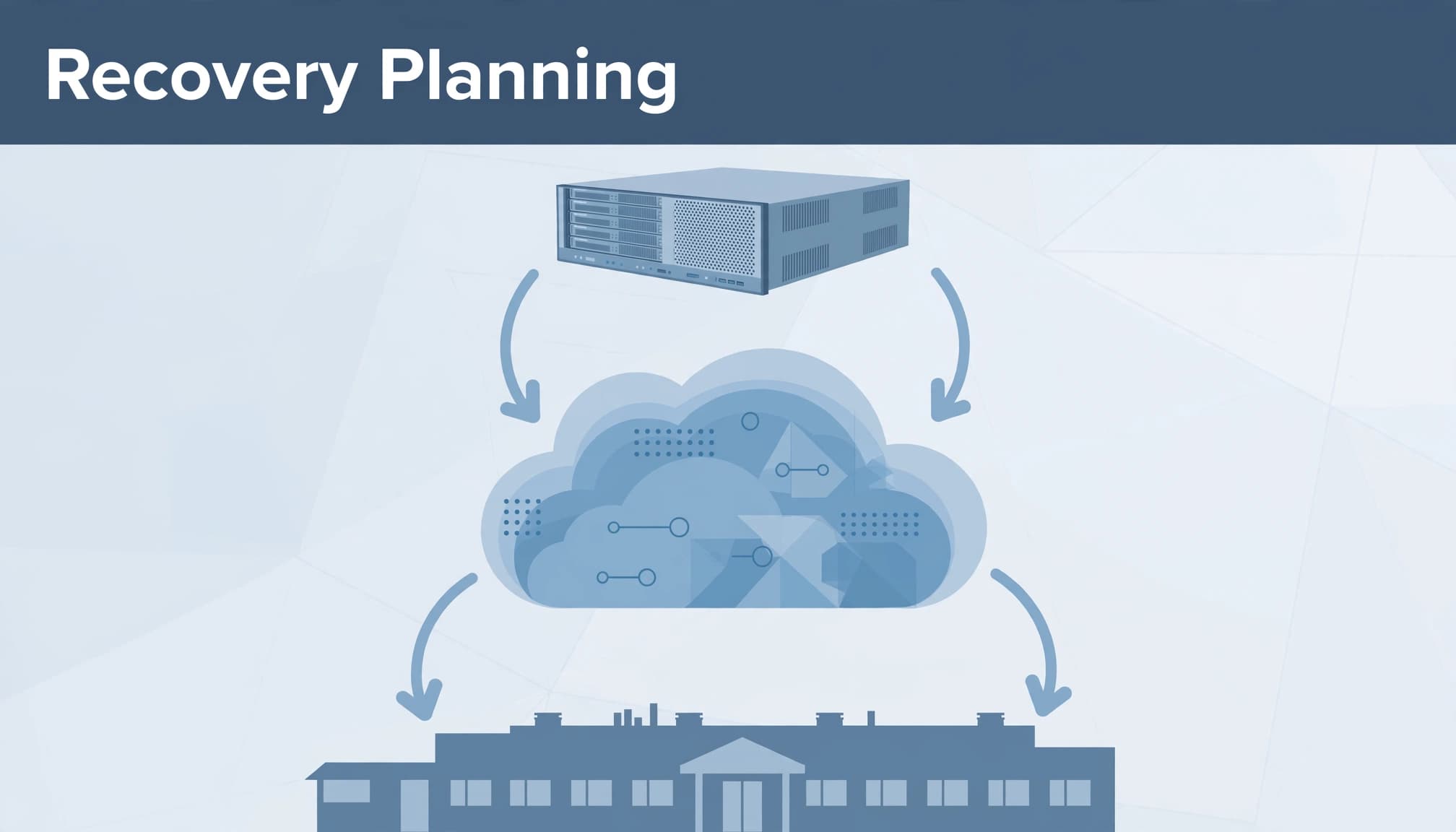
Protect the backup against compromised administrator accounts and test complete restoration. Include identity, network configuration, application dependencies and supplier access, rather than testing isolated files.
A successful completion notification doesn’t establish recoverability. Record restoration results and maintain downtime procedures for clinical work that can’t wait.
Compare the whole contract cost
There’s no reliable single price for healthcare IT support. Cost depends on users, devices, sites, clinical applications, support hours, security coverage and the work retained by your internal team.
BCN’s G-Cloud 14 end-user and IT support listing shows a price of £1,000 a unit. That’s a catalogue example, not evidence of a per-user monthly rate or a complete clinic budget.
Providers may charge per user or device, use a fixed monthly agreement, or price projects separately. Compare the same scope across quotations, including onboarding, licences, onsite visits, security tools, backups and out-of-hours work.
Public-sector buyers also need the appropriate procurement route. G-Cloud 13 and G-Cloud 14 have enabled eligible public bodies, including NHS organisations, to buy listed cloud services and support without a full standalone tender. Catalogue buying still requires documented evaluation and compliant call-off procedures.
The G-Cloud 14 framework was extended for lots 1 to 3 until 28 October 2026. G-Cloud 13 is an earlier framework, so references to it shouldn’t imply it’s still available for new purchases.
Assess minimum terms, renewal increases, exclusions and exit charges alongside the monthly fee. Require documented data export, credential handover and transition assistance. A lower fee can be offset by expensive project rates or an unsupported exit.
Use the first 90 days to establish ownership
A practical onboarding plan should establish ownership before major changes begin. The sequence depends on the environment, but support should not start with undocumented administrator access or an incomplete asset list.
Agree These Initial Milestones:
- During days 1 to 30, inventory users, devices, clinical applications, licences, suppliers and privileged accounts. Record unsupported systems, current incidents and backup coverage. Assign service owners and escalation contacts while protecting established clinical workflows.
- During days 31 to 60, address priority access weaknesses, deploy agreed monitoring and set patching windows. Document responsibility for medical devices and systems that need manufacturer approval before changes.
- During days 61 to 90, test restoration, rehearse a major incident and review support performance. Record unresolved risks, agreed exceptions and the next improvement priorities.
Measure progress through owned risks and completed tests, not ticket volume alone. Useful measures include repeated incidents, overdue critical patches, restoration results and time spent waiting for third-party action.
Our IT support for healthcare organisations combines day-to-day assistance with maintenance and monitoring. Onboarding should make these responsibilities clear to clinical and administrative teams.
Frequently Asked Questions
What should healthcare IT support include?
A managed service may cover user assistance, device maintenance, security monitoring, patching, backups and supplier coordination. Clinical applications need clear ownership, since the IT provider may not control the record system or its hosting platform.
How does managed support differ from contract staffing?
Managed support provides an ongoing service with agreed responsibilities, tools and performance commitments. Contract staffing fills a defined capacity gap, while the organisation usually retains responsibility for priorities, supervision and service performance.
What should a healthcare IT support SLA define?
An SLA should cover incident priorities, acknowledgement, technical engagement, restoration targets, updates and escalation. A response target alone doesn’t show when clinicians will regain access to a system.
How should healthcare organisations plan IT recovery?
Set a recovery point objective and recovery time objective for each clinical system, then include them in recovery plans and restoration tests. Test identity, network configuration, application dependencies and supplier access, and maintain downtime procedures for clinical work.
Which compliance and assurance requirements should suppliers address?
UK GDPR and the Data Protection Act 2018 apply to the organisation’s processing of patient data, and outsourcing doesn’t transfer its accountability. Review supplier access and processing arrangements, and assess NHS DSPT status, certifications and technical evidence as separate parts of supplier assurance.
Define the service before signing
Secure clinical services depend on clear ownership of clinical dependencies, appropriate access and recoverable systems. Certifications and response targets provide useful evidence, but they don’t define the full service.
Choose the operating model and contract around your clinical hours, internal capacity and recovery requirements. Document any gaps before they become accepted assumptions.
Speak to our team about IT support and consultancy to define a support, security and cloud plan for your organisation’s clinical systems.